


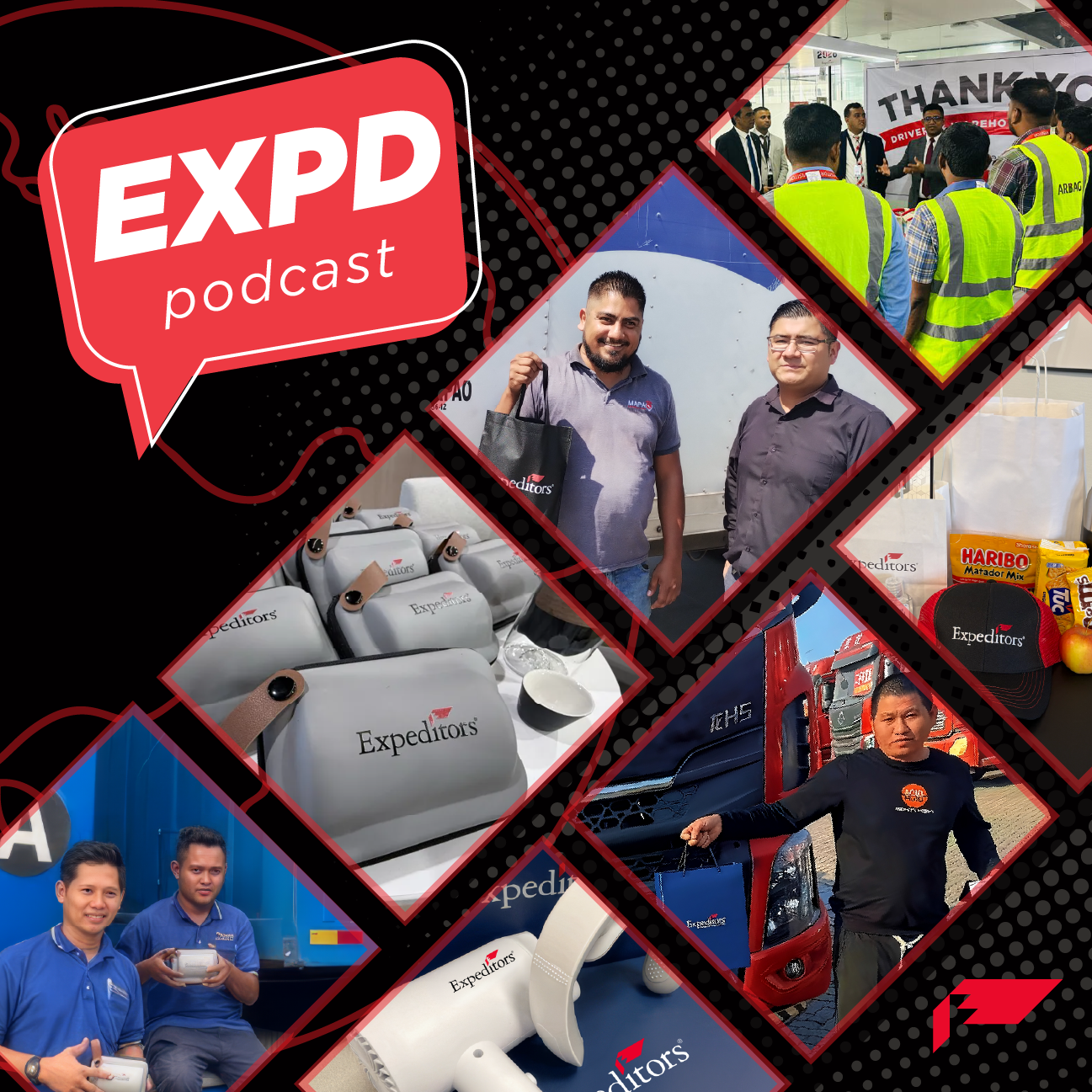
In this week's episode, Darren Bowman, Senior Vice President of Transcon, shares a message of gratitude for the truck drivers whose hard work and dedication are essential to global commerce.
He also discusses the current state of the trucking industry, including driver shortages, capacity challenges, and rising transportation demand, while sharing insights on how organizations can better support drivers and plan for future transportation needs.
You're listening to Current Position, a weekly briefing from Expeditors mapping the shifts across trade compliance, regulatory changes, and global supply chains, plus some market insights from our Senior Vice President of Transcon, Darren Bowman.
I'm Chris Parker, and here's the latest from September 9th to September 15th.
Global Customs & Trade Market
As more tariffs get implemented globally, and geo-political conflicts have risen shipping prices worldwide, some companies are turning back to China suppliers.
A year into the “China plus one” diversification push, some manufacturers report that Vietnam, India and Indonesia struggle to match China’s manufacturing networks in terms of skilled labour and capacity. Many have said narrowing tariff differentials and energy-reliability concerns have also reduced the benefits of shifting their sourcing.
Global Ocean Market
Intra-Asia freight rates have increased, and congestion has compounded across the region, creating bottlenecks at key transshipment hubs. Hubs in China, Singapore, Hong Kong, and Busan have seen increasing congestion due to multiple back-to-back typhoons and an extended peak season export surge. These factors have led to over 2.4 million TEUs being delayed across North Asia, increased vessel wait times, and inland transportation capacity constraints. Shippers are encouraged to build an extra 1-2 weeks of lead time into planning, evaluate alternative routing options and prepare for the potential of continued volatility.
Low water levels on sections of the Rhine and Danube continue to constrain cargo movements into parts of Central Europe. The lower levels inhibit inland barge operations, reducing available capacity, and preventing the efficient movement of cargo from some inner areas of the region. European shippers should continue monitoring vessel schedule reliability as global port congestion and weather-related disruption remain elevated.
U.S. container import volumes have stretched the traditional peak season into September. The Global Port Tracker shows an expected 2.31 million TEU of imports in September, which would surpass May volumes of 2.24 million TEU. Vessel delays from severe weather in China and drought rerouting from the Panama Canal had a definite impact on arrivals. Given sustained volumes and other extenuating factors, shippers should expect schedule-reliability and congestion risk to continue into fall.
Global Air Market
The U.S. Department of the Treasury on Sept. 8 launched a significant expansion of sanctions targeting Iran's aviation sector. The action designated several companies outside Iran alleged to have supported Iranian aviation activities through cargo handling, logistics, aircraft support services, or procurement. The sanctions not only impact goods moving in and out of Iran, but also several airlines operating into Türkiye.
Air cargo volumes dipped last week due to extended Middle East hostilities and Asian holidays impacting demand. According to WorldACD, global tonnage was down 1% in week 36, but still up 7% year-on-year. Experts say renewed Gulf hostilities and national holidays in Vietnam and Malaysia decreased traffic. Average worldwide rates held near $3.00 per kg as capacity slipped 1%, though Hong Kong–Europe volumes rose a third straight week. With oil back above $100 a barrel, higher jet-fuel surcharges are expected to add further pressure on rates.
Global Ground Transport Market
Companies like Maersk and CMA have increased their emergency inland fuel rates across Nordic and Baltic road freight. The company increased their inland fuel/energy surcharge on Store Door shipments by 20% in Estonia, 13% in Denmark and 12% in Latvia. CMA CGM has separately applied a 3% inland surcharge in Belgium and the Netherlands beginning Sept. 8.
European Commission leaders appear to be allowing nine EU countries some flexibility on the implementation of the EU’s Entry/Exit System (EES). Belgium, France, Germany, Greece, Italy, Malta, the Netherlands, Portugal and Switzerland previously petitioned Brussels for more lead way in using the system given concerns that full checks would significantly increase border check timing.
Up next, Senior Vice President of Transcon, Darren Bowman.
The following discussion could include forward-looking statements. Of course, actual results may differ materially because of various risks and uncertainties. We are not obligated to update these statements, and we rarely do so. Instead, we refer you to our most recent SEC filings for more information about the risk factors that could affect our future results.
Chris Parker: Darren Bowman, it is a pleasure to have you here on Current Position this week. How are you doing, sir?
Darren Bowman: Doing terrific, Chris. Nice to see you.
Chris Parker: It's great to have you. And I want to say, as Senior Vice President of Transcon, and Transcon covers trucking, happy National Truck Driver Appreciation Week to you and to all of our carriers and all of our partners.
Darren Bowman: It's a great time to get together with you. And to all the drivers, carrier partners, load planners, fleet managers, and your families, a sincere thank you for all that you do. The week on recognition and appreciation for the drivers. And around the globe, there's a massive driver shortage. So it's critical that we ramp up our game to take care of the men and women who deliver our cargo to and from all the countries that we work in.
Chris Parker: What does a shortage look like right now? How has the truck driver population been affected? What are the conditions leading to shortages?
Darren Bowman: Well, at the end of the day, it seems like the young folks don't want to drive trucks anymore. The driver shortage is a global structural deficit. It's actually a single common thread across every region around the globe.
Around 2.9 million truck driver positions, about 11% of the workforce remain unfilled across 18 markets. And it looks to be worse over the next few years.
Europe especially, Europe has the highest shortage rates at about 13%, around 502,000 unfilled truck driver positions in Europe alone. And it looks to be over 750,000 by 2028. That also affects capacity, reduction of capacity in the market. And it's critical with the volume that's moving today and will continue to move to solve for this massive gap that we have.
Chris Parker: And you're saying, I guess the truck driving profession is not attractive enough to the younger populations. What does the aging out population look like? How many retirees do you think we're going to be looking at? I mean, is it a typically older population that serves as truck drivers?
Darren Bowman: Well, for Europe specifically, the average truck driver is about 47 years old. However, 30% are over 55 today. And the under 25 demographic is only 2.2% of the workforce. You're looking for more drivers to retire, plus that number is going to continue to increase.
There's a lot of smart people involved. And getting a truck driver appreciation week, it's really doing the simple things right. Showing respect, gratitude, and appreciation, making the truck driving game a more attractive opportunity. And it is. It's the backbone of all the commerce that we do across the globe. Delivering cargo to and from stores, retailers, businesses, et cetera.
Chris Parker: With that concern in mind about a population aging out, it's hard to attract younger drivers. What are fleets out there looking to do to try and mitigate this? How are they trying to incentivize this role a little bit more, make it more attractive? What has been done out there right now to account for the shortage of drivers?
Darren Bowman: Yeah, making things more attractive, if you will 24-7 access on the resets when the drivers are off the road with showers, clean bathrooms, facilities that they can use, exercise equipment. Standard things that we come to expect in this day and age, which is not always available to drivers. And then the customers that they have to deal with each and every day, freight forwarders, companies like ourselves, give them clear instructions, get them back on the road, do their job, and get back to their family.
Simple things like a lit parking lot, safety and security, is a big issue as well. And clear and accurate descriptions of where the pickup is, where the delivery is, try not to put too many curve balls in the mix or cancel capacity after it's booked. Just simple things, showing respect, appreciation, and support.
Chris Parker: So the taking care of our drivers is one way to keep the driver population full, to make sure that there's enough jobs taken up to keep that capacity available. What other factors are affecting capacity? Is it just the fact that there's not enough drivers out there or are there other things at play?
Darren Bowman: Hyperscalers, moving a high-value cargo to and from all points in North America, as well as Europe. So the security requirements for that cargo, tremendous and expected, as well as the expectation to use teams and team only drivers.
So even though it may be short distances, they want team access and team capacity. And in the market within North America, specifically, there's a difficulty from most of the large fleets, as well as the regional fleets, to keep team capacity. Why, you might ask? It's much easier to drive a single and get home every other night, four or five, 600 miles, and every weekend, and then do reset and get back out on the road. But long haul driving absolutely requires teams. And there's been a reduction of teams over the last few years in a dramatic sense.
There's only about 3000 teams that exist in North America alone. And that's combining most of the major players, the direct asset trucking companies for full truck load. So capturing that capacity is critical. And forecasting for that capacity is critical, which doesn't necessarily exist in the hyperscaler market today. And by hyperscalers, it's the folks creating the data chips, the servers, the high value cargo that moves, not to mention all the high value retail that moves within North America, Europe, Asia.
But back to the teams, there's a limited number of teams available, but it's critical that you team networks for the transport of this high value cargo. Because there are material elements and groups within North America and Europe that target this cargo. And based on the regulation forces that have impacted America, it obviously shrinks the pool of available drivers, leading to higher rates and tighter capacity.
Chris Parker: So you've got an exploding industry, right? That is taking up a lot of market share in terms of drivers, teams, capacity. The same thing was happening, I talked with Carl about in air. And then you've also got a driver shortage here. For folks listening, companies out there, what kind of conversations should they be having with their teams internally to account for this kind of situation?
Darren Bowman: What we would suggest is capturing the direct asset capacity with teams. With a limited number of teams in North America, specifically, pre-capture the capacity. So the forecasting, because it's fast and furious with the hyperscaler market, doesn't always come with the appropriate time, which usually is 48 hours before you capture that team. Again, a limited number of assets available, limited number of teams, a lot of high-value cargo moving throughout the globe. Candidly, you want to pre-book and pre -capture that dedicated team capacity.
Chris Parker: Clear, concise, and get those drivers back home. That's what's going to make freight attractive.
Darren Bowman: That's right.
Chris Parker: Thank you so much, Darren, for the time. Appreciate the insight.
Darren Bowman: Nice spending time with you, Chris. Anytime. Look forward to our next conversation.
You are now at our current position. Links to everything we covered today, plus some extra articles of interest, are in the show notes.
And while you're there, check out the events and webinars we flagged for the weeks ahead. Thank you for listening, and we'll see you next week.
Be sure to subscribe to your preferred podcast platform so you don't miss future episodes. To learn more about Expeditors, you can find us on LinkedIn, Facebook, Instagram, and X, or simply visit us at expeditors.com. Take care, and I'll see you next time!
© Expeditors International of Washington, Inc. All rights reserved. No reproduction, redistribution, or retransmission is permitted.